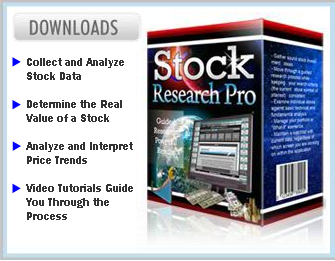

Welcome to Stock Research Pro

Stock Research Pro is a powerful software application designed to streamline the stock research and evaluation process. Our software will take you through all aspects of stock research, from idea generation and analysis, to valuation and portfolio tracking.

We developed this website and our stock market software package to make stock market research a more streamlined and logical process for both new and seasoned stock market investors.


______________________________________________

What Insider Buying and Selling
Can Tell Investors

January 6, 2009, 0 comments

Click here to learn more about Stock Research Pro Investment Software

Insider buying or selling refers to the purchase or sale of company stock by a corporate insider. Numerous studies have shown that when insiders buy and sell shares of their own companies, they typically fare better than most stock market investors. SEC rule dictates the parameters in which insiders may engage in company stock transactions. Insider transaction information is recorded for public record and is available for review in the company’s annual report.
Read the rest of this entry »

Tax Equivalent Yield and Municipal Bonds
(includes calculator)

January 5, 2009, 0 comments

Click here to learn more about Stock Research Pro Investment Software

The Taxable Equivalent Yield is the return that an investor would require on a taxable investment in order to make it equal to the return on a tax-exempt investment. The taxable equivalent yield calculation is commonly applied when evaluating municipal bond investments as the primary appeal of municipal bonds is that the interest income is exempt from regular federal income taxation. Many are exempt from state taxation as well.
Read the rest of this entry »

Over-the-Counter (OTC) Stock Investing

January 4, 2009, 0 comments

Click here to learn more about Stock Research Pro Investment Software

An Over-the-Counter (OTC) stock is a security that is traded in an environment outside of the formal exchanges, such as the NYSE and the AMEX. Unlike the matchmaking service seen in these specialist exchanges, trading in the OTC market is made possible through a network of middlemen who carry securities in inventory facilitate the buy and sell orders of investors.
Read the rest of this entry »

Understand and Calculate the Current Ratio

January 3, 2009, 0 comments

Click here to learn more about Stock Research Pro Investment Software

The Current Ratio, a test of a company’s financial strength, is primarily used as an indication of a company’s ability to pay off its short-term liabilities with its short-term assets- cash, inventory and receivables. The higher the current ratio, the more able the company is to pay these obligations. Lower values in the current ratio indicate that the company may have problems paying its short-term debts.
Read the rest of this entry »

How to Calculate the Return on Assets Ratio

January 2, 2009, 0 comments

Click here to learn more about Stock Research Pro Investment Software

The Return on Assets (ROA) ratio provides an indication of how profitable a company is relative to its total assets. The ROA ratio demonstrates how much income management has been able to produce from a dollar’s worth of company assets. For this reason, investors often use this ratio to evaluate company management.
Read the rest of this entry »

Understanding the Mutual Fund Expense Ratio

January 1, 2009, 0 comments

Click here to learn more about Stock Research Pro Investment Software

The mutual fund expense ratio (or management expense ratio) is a measure of the cost the investment company incurs to operate the fund. It is expressed as an annual percentage of invested assets that the investment company retains to pay for the management and operation of the fund. These operating expenses are deducted from the fund’s assets and decrease the return to the fund’s investors. The expenses are known as the “load” the fund carries.
Read the rest of this entry »

Hedge Strategies for the Individual Investor

December 31, 2008, 1 comment

Click here to learn more about Stock Research Pro Investment Software

For investors, hedging is the practice of purchasing securities in a combination that reduces portfolio risk. Under most hedging strategies, the investor will take two positions with negative correlations. The two most common financial instruments used for hedging are options and futures. While there is no way to completely eliminate market risk, proper execution of hedging strategies can reduce that risk.
Read the rest of this entry »

Growth Investing and Small-Cap Stocks

December 30, 2008, 0 comments

Click here to learn more about Stock Research Pro Investment Software

Small-Cap stocks (stocks with small market capitalization) are generally defined as companies with a market capitalization of between $300 million and $2 billion (although the small-cap classification can vary among brokerage houses). While these securities trade with higher risk profiles than larger-caps, they can offer greater upside potential and may be appealing to investors who can tolerate the volatility.
Read the rest of this entry »

Value Investing and a Margin of Safety

December 29, 2008, 0 comments

Click here to learn more about Stock Research Pro Investment Software

Investing with a margin of safety is a principle conceived of by Benjamin Graham, who is considered by many to be the “father of value investing“. Under this principle, the investor looks to purchase when the actual or “intrinsic” value of the stock is believed to be significantly above the market price. The difference between the two prices is the margin of safety. The idea is that buying with a wide margin of safety minimizes the downside risk associated with the investment.
Read the rest of this entry »

A Bond Equivalent Yield Calculator

December 28, 2008, 0 comments

Click here to learn more about Stock Research Pro Investment Software

The Bond Equivalent Yield (BEY) is a formula for describing the yield on a bond while taking into consideration multiple factors regarding the interest on the bond. The BEY enables the comparison of fixed-income securities whose payments are not annual against securities with annual yields. The bond equivalent yield is the yield that is quoted in newspapers.
Read the rest of this entry »


          Subscribe to Stock Research Pro